
What is early identification and support?
Understanding early identification and support
Early identification of mental health problems at school involves recognizing signs that a student may be experiencing an emerging or escalating mental health problem. While educators and other school staff are not mental health professionals and cannot diagnose a mental health disorder, they are often the first ones to notice a change in a student’s behaviour or emotions and therefore have a critical role in highlighting a potential concern and helping the student and their family towards appropriate services. At the same time, school staff can provide ongoing support for students who may be experiencing problems with their mental health, through compassionate classroom care as the student moves to, from and through formal mental health services at school or in the community.
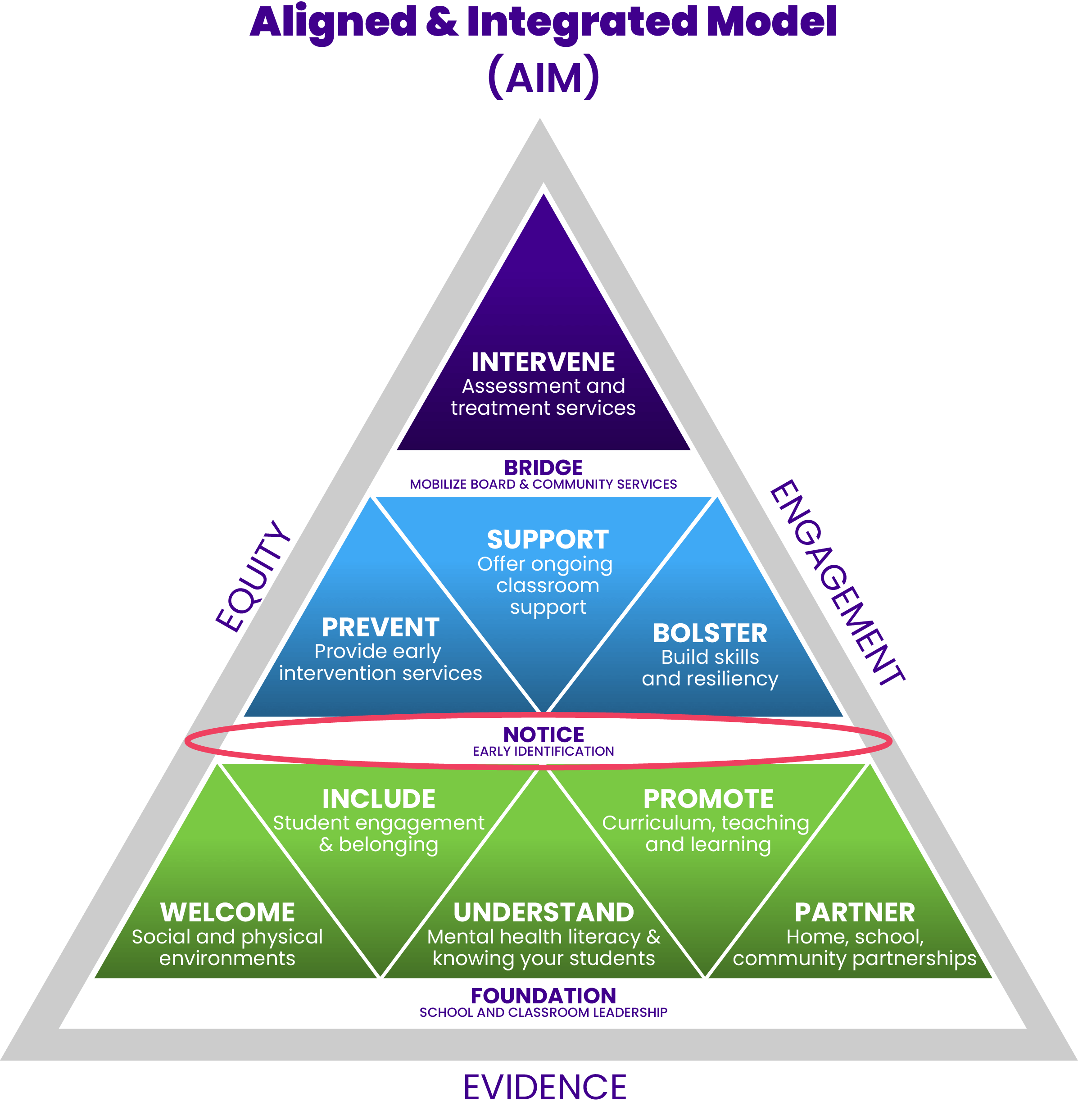
Mental health promotion is foundational to early identification and support, because it focuses on wellness habits, student engagement and leadership, stigma reduction, social-emotional skill development and mental health literacy, which helps students care for their mental health, support others, and know when and how to seek help. Similarly, it is essential to have a robust system of support, including strong prevention and early intervention services at school, wrapping around students who are identified as having a possible mental health concern. Within a multi-tiered system of support, early identification and support is the bridge between mental health promotion (Tier One) and prevention and early intervention (Tier Two).
At the centre of strong early identification and support is a focus on relationships. School staff know students well and are often the first adults that students turn to when they need mental health support. Equipping school staff with information about signs of common mental health problems and how best to respond in the moment and over time is an important part of a comprehensive mental health strategy.
What the research tells us
- Mental health problems are often first noticed at school, and this setting is the primary place that most students and families reach out to for support.
- Early identification and intervention can improve mental health outcomes and reduce the need for more intensive services later on.
- Receiving early access to supportive interventions can contribute to better outcomes for students (e.g., educational/occupational/social outcomes).
- Early identification and intervention may prevent substance-related disorders and suicide.
- Early identification and support promotes opportunities for professionals to work with students to notice and nurture their own strengths and skills, which may foster help-seeking behaviours and problem-solving skills that can contribute to healthy development and overall well-being.
Why this is important
Schools are uniquely positioned for their role in early identification, given that students spend much of each day, from September through June, with educators and school staff. School staff develop supportive relationships with students and are often the first to notice changes in their behaviour or emotions that could signal an emerging or escalating mental health problem. Further, as trusted adults, school staff can provide the immediate support that can make a difference in a student’s daily experience by listening, acknowledging their concerns, making connections to needed services and helping to promote a sense of wellness and stability at school. This can also mean working with mental health service providers to reinforce skills and strategies designed to help the student to be successful at school.
Early identification of mental health concerns can lead to quicker responses and better outcomes for students. When these concerns are noticed early, students can receive the support they need before challenges grow larger or begin to impact learning and relationships. Caring adults at school have an important stabilizing role for young people who are struggling with mental health problems.
Brownlie, E., Beitchman, J. H., Chaim, G., Wolfe, D. A., Rush, B., & Henderson, J. (2018). Early adolescent substance use and mental health problems and service utilisation in a school-based sample. The Canadian Journal of Psychiatry, 64(2), 116–125. https://doi.org/10.1177/0706743718784935
Duong, M. T., Bruns, E. J., Lee, K., Cox, S., Coifman, J., Mayworm, A., & Lyon, A. R. (2020). Rates of Mental Health Service Utilization by Children and Adolescents in Schools and Other Common Service Settings: A Systematic Review and Meta-Analysis. Administration and Policy in Mental Health and Mental Health Services Research, 48(3), 420–439. https://doi.org/10.1007/s10488-020-01080-9
Goodyear-Smith, F., Martel, R., Darragh, M., Warren, J., Thabrew, H., & Clark, T. C. (2017). Screening for risky behaviour and mental health in young people: the YouthCHAT programme. Public Health Reviews, 38(1), 20. https://doi.org/10.1186/s40985-017-0068-1
Groenman, A. P., Janssen, T. W., & Oosterlaan, J. (2017). Childhood Psychiatric Disorders as Risk Factors for Subsequent Substance Abuse: A Meta-Analysis. Journal of the American Academy of Child & Adolescent Psychiatry, 56(7), 556–569. https://doi.org/10.1016/j.jaac.2017.05.004
Ligier, F., Giguère, C., Notredame, C., Lesage, A., Renaud, J., & Séguin, M. (2020). Are school difficulties an early sign for mental disorder diagnosis and suicide prevention? A comparative study of individuals who died by suicide and control group. Child and Adolescent Psychiatry and Mental Health, 14(1), 1. https://doi.org/10.1186/s13034-019-0308-x
Patel, V., Flisher, A. J., Hetrick, S., & McGorry, P. (2007). Mental health of young people: a global public-health challenge. The Lancet, 369(9569), 1302–1313. https://doi.org/10.1016/S0140-6736(07)60368-7
Waddell, C., Georgiades, K., Duncan, L., Comeau, J., Reid, G. J., O’Briain, W., Lampard, R., Boyle, M. H., & Team, O. C. H. S. (2019). 2014 Ontario Child Health Study Findings: Policy Implications for Canada. The Canadian Journal of Psychiatry, 64(4), 227–231. https://doi.org/10.1177/0706743719830033