


When students are centred, mental health support becomes proactive, responsive and inclusive. Schools focus on creating conditions where all students can feel safe, connected and supported to learn and thrive – every day, in every classroom.
Centring every student helps schools and systems to:
- Promote belonging and connection, which are foundational to well-being and learning.
- Reduce barriers to support, especially for students who experience systemic inequities.
- Respond earlier and more effectively when students need help.
- Strengthen trust between students, families, schools and communities.
Research and student voice consistently suggests that when students feel seen, heard and valued, they are more engaged in learning and more likely to seek support when they need it.
“When you provide mental health strategies and coping skills, it helps reduce the struggle later in life… Everyone goes through stressful parts in life… The more we learn about ways to navigate through those events, the better.”
– Ontario secondary student, 2025
Students at the centre of the SMH-ON strategy
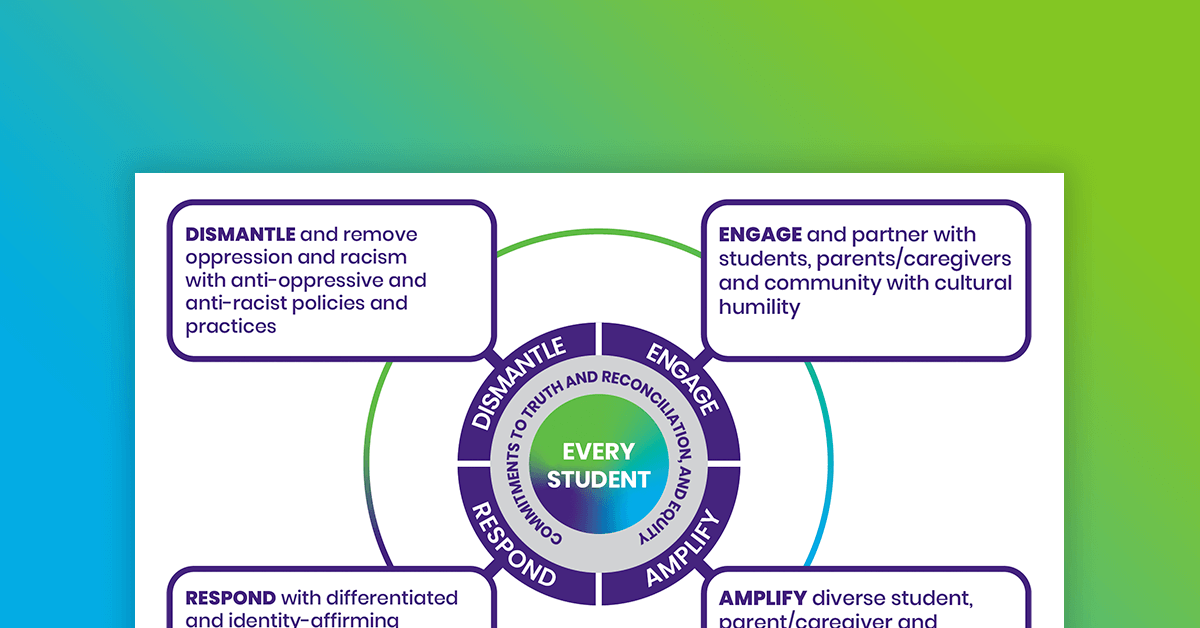
In the School Mental Health Ontario strategy, students are intentionally placed at the centre of the visual and the work itself. Surrounding them are the relationships and systems that support well-being: home, school and community.
This visual reinforces the fact that student mental health grows through connection.
Schools do not work in isolation – parents/caregivers, families, Elders, faith leaders, community and cultural organizations, sports/recreation spaces and service providers all contribute to a circle of care around students.
The strategy also emphasizes that mentally healthy systems, schools and classrooms are a prerequisite for effective mental health promotion, prevention and intervention. When everyday environments support well-being, students are better positioned to benefit from more targeted supports when needed.
Honouring commitments to Truth and Reconciliation and equity
Also surrounding every student in the School Mental Health Strategy is a focus on Commitments to Truth and Reconciliation and equity. Mental health is deeply connected to how safe, valued and respected students feel in their learning environments.
This means:
- Recognizing that students hold multiple, intersecting identities.
- Understanding how racism, discrimination and systemic barriers rooted in colonization affect student mental health and access to care.
- Honouring commitments to Truth and Reconciliation, and to culturally responsive and inclusive practice.
- Building on individual, cultural and community strengths, rather than focusing only on challenges.
- Including identity-affirming approaches to help create environments where students can bring their whole selves to school without fear of judgment or exclusion.
A shared responsibility
Centring every student is not the work of one role or one program; it is a shared commitment across the education system.
- Students shape mental health efforts through their voice and leadership.
- School staff build caring relationships and inclusive learning environments.
- School and system leaders create the conditions for equity, consistency and sustainability.
- Families and communities contribute culture, connection and care.
Together, this shared responsibility ensures that every student has access to evidence-informed, culturally responsive mental health care at school.
The Thomas B. Fordham Institute. (n.d.). Children learn best when they feel safe and valued. https://fordhaminstitute.org/national/commentary/children-learn-best-when-they-feel-safe-and-valued