
About child and youth mental health in Ontario
Understanding mental health and substance use health
Mental health and mental illnesses are related, but they aren’t the same things, and understanding this difference is important.
What is mental health?
The World Health Organization defines mental health as a positive state of wellness and flourishing that allows you to feel, think and act in ways that help you enjoy life and cope with its challenges.
For children and youth, good mental health:
- supports learning and engagement
- strengthens social connection and belonging
- builds resilience and coping skills
When students experience good mental health, they are more ready to learn, feel a stronger sense of belonging at school and perform better academically.
Many perspectives help us understand mental health and well-being. For example, the First Nations Mental Wellness Continuum Framework describes wellness as “a balance of the mental, physical, spiritual, and emotional” aspects of life. This holistic view reminds us that everyone, including those experiencing mental illness or vulnerability, holds the strength and capacity to live in balance and wholeness. Increasingly, across models for understanding mental health, there is a focus on flourishing and wellness, recognizing that mental health is more than the absence of mental illness. Like physical health, it is something we all have and need to care for over time.
What are mental illnesses?
Mental illnesses are conditions that affect mood, thinking or behaviour and can significantly interfere with daily life over time. Examples of mental illnesses include mood disorders, anxiety disorders, schizophrenia, eating disorders and substance use disorders.
The brain plays an important role in our thoughts, emotions and behaviours, which is why mental illnesses are often thought of as being a disease of the brain. While this is partly true, mental illnesses are also influenced by a range of factors and experiences, including:
- genetics
- social conditions (often referred to as social determinants of health), (e.g., income and social status, physical environments, race and racism, access to health services)
- experiences of trauma or chronic stress
It’s good to remember that even when we, or our students, are experiencing more serious mental health concerns, recovery and wellness are possible.
Why this is important in schools
Schools are everyday places of learning, relationships and belonging. Because of this, they play a critical role in supporting mental health for all students.
When schools:
- promote positive mental health,
- notice early signs of distress, and
- provide timely, culturally responsive supports
students are more likely to feel connected, engaged and ready to learn.
What the research tells us
Some forms of mental illness are rare (e.g., one percent of the Canadian population suffers from schizophrenia). Other types of mental health disorders are more common. Overall,18% of Canadians over 15 years of age met the diagnostic criteria for a mood, anxiety or substance use disorder in the previous 12 months.
Data related to children and youth indicates:
- Approximately 70% of mental health and addiction issues begin in childhood and adolescence.
- 18-22% of students in Ontario, or approximately one in five students aged four to 17, meet the criteria for a mental illness.
- The most common forms of mental health problems for children and youth relate to disorders of:
- attention
- anxiety
- mood
- behaviour
- Early identification and early intervention helps to improve outcomes for young people.
- Schools have been identified as a key setting for mental health promotion, early identification, prevention and early intervention services, and are the first place many young people go for mental health go for mental health support.
For more information, see Student mental health at a glance.
What is the difference between distress and a disorder?
Everyone experiences ups and downs. Stress, sadness, worry or changes in behaviour can be part of typical development – especially during adolescence. Because of this, it can be challenging to determine if changes you observe are simply a typical reaction or normal fluctuation, or if it’s something more serious requiring treatment. For younger children, mental health concerns can often go undiagnosed because children don’t always express their feelings and thoughts in a way that signals a mental health problem.
A helpful rule of thumb is to pay attention when changes:
- last more than two weeks,
- cause distress, and
- negatively impact day-to-day life.
When this happens, it’s a sign that additional support may be needed.
Understanding the relationship between mental health and mental illness
Mental health is more than the absence of mental illnesses. It is a positive state of wellness and flourishing. Note that even when experiencing a mental illness, it’s possible to feel mentally well. It’s also possible to have problems with mental health and not have a mental illness. The dual continuum model helps explain the relationship between mental health and mental illness, as two separate but interconnected concepts.
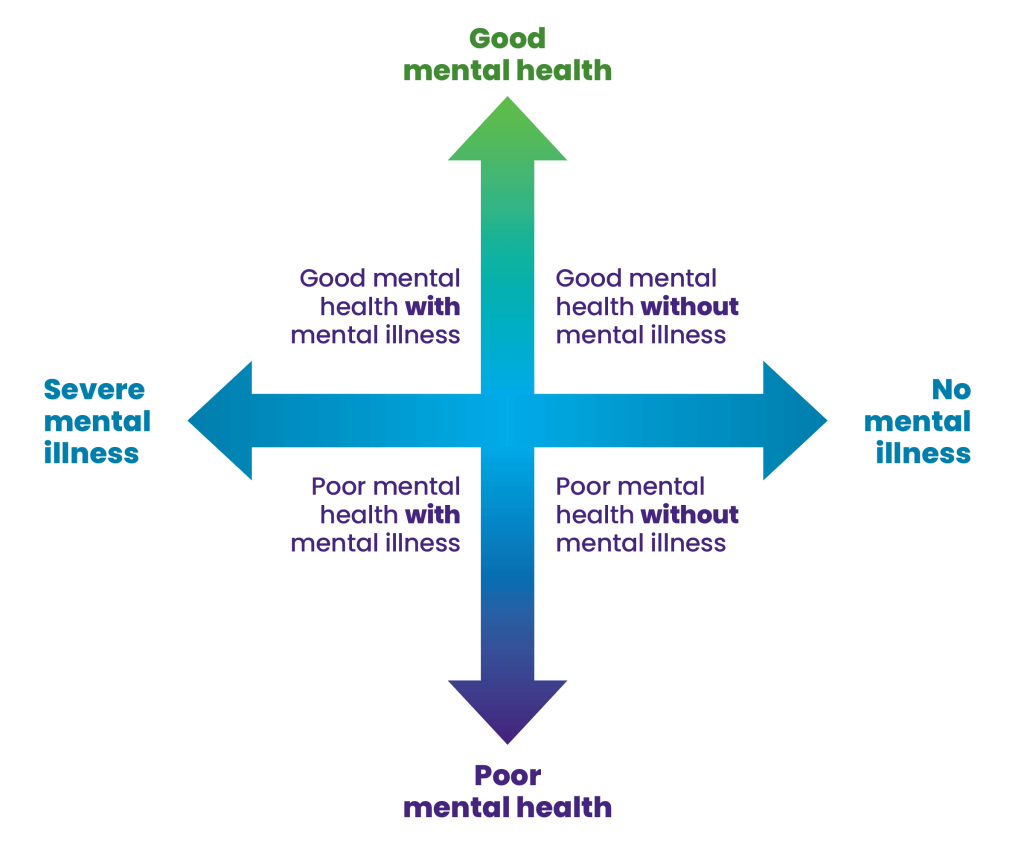
This graphic is a visual representation of the dual continuum model of mental health. The graphic is divided into four quadrants with a two-sided arrow running through the middle both vertically and horizontally. The arrows represent a continuum on both axes. The north south axis is labelled “good mental health” on the top and “poor mental health” on the bottom. The east west axis is labelled “no mental illness” on the right and “severe mental illness” on the left. The upper right quadrant reads “good mental health without mental illness”. Moving clockwise from here the lower right quadrant reads “poor mental health without mental illness. The bottom left quadrant reads “poor mental health with mental illness”. The upper left quadrant reads “good mental health with mental illness
On the horizontal arm of the dual continuum, an individual may find themselves somewhere along the line between experiencing ‘no mental illness’ and struggling with ‘severe mental illness.’ Note that positioning can change over time, with treatment or with changes in life circumstances. At the same time, along the vertical arm of the continuum, an individual may be in a state of good or poor mental health, or anywhere in between.
Again, this sense of well-being can change over time and is not static. The implication is that:
- A person can have a mental illness and still experience positive mental health.
- A person can have no mental illness but still experience poor mental health.
In schools, this understanding reinforces why mental health promotion and literacy are beneficial for every student, not just those experiencing illness. Everyday practices can strengthen well-being wherever a student may be on the continuum.
This short video from the Centre for Addiction and Mental Health (CAMH) describes the dual continuum model in more detail:
Substance use health
Substance use health is part of overall health and well-being. It recognizes that substance use exists on a spectrum and that people’s experiences with substances can change over time.
Rather than focusing only on illness or abstinence, substance use health looks at both potential benefits and risks, and supports informed, compassionate, and evidence-based responses.
What is substance use health?
Substance use health describes the full range of ways people may interact with substances, from no use to lower-risk use, to higher-risk use, and, for some, substance use disorders.
This approach:
- recognizes that some substances may be used in health-promoting ways (for example, medicinally or ceremonially)
- acknowledges that substance use can also carry risks and negative impacts
- emphasizes understanding, prevention and support rather than judgement.
CAPSA offers this visual to show the spectrum of substance use health, from no use, through lower use, higher use, declining health and substance use disorder. Everyone has a place on the Substance Use Health Spectrum, and that place can shift over time depending on life circumstances, stress, supports and environment:
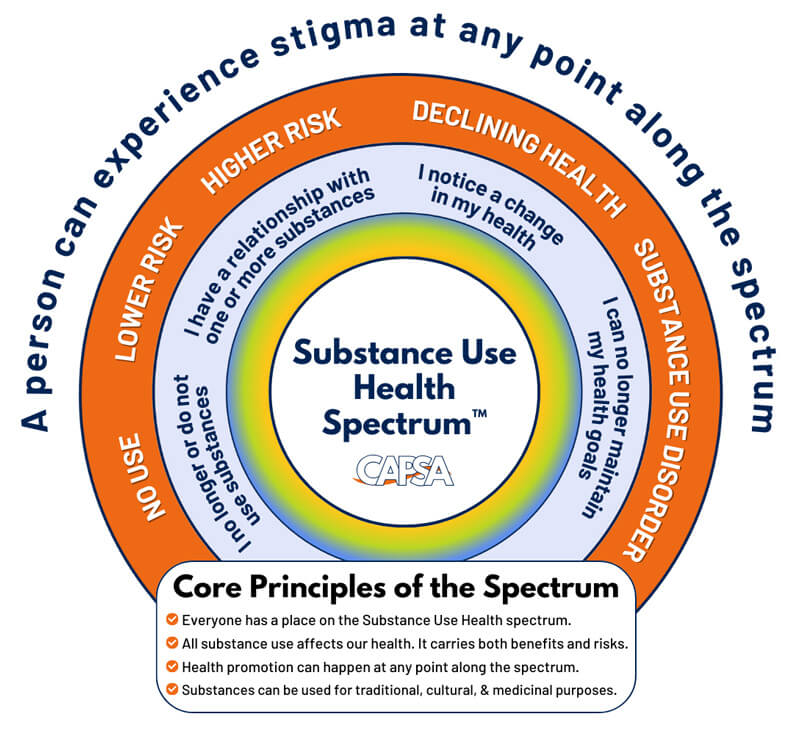
The image is a circular infographic titled “Substance Use Health Spectrum.” It shows substance use as a range, that everyone has a place on the spectrum, and that that place can shift over time.
At the centre is a small circle labelled “Substance Use Health Spectrum (CAPSA).” Surrounding it are several coloured rings that move outward, showing different experiences along the spectrum.
The inner ring represents the relationship with substances, with labels “I no longer or do not use substances, I have a relationship with one or more substances, I notice a change in my health, I can no longer maintain my health goals.” Moving outward, the colours shift and the labels describe levels of risk, including: “No use, lower risk, higher risk, declining health, substance use disorder.”
Along the top of the image, curved text reads: “A person can experience stigma at any point along the spectrum.” This emphasizes that stigma can affect people regardless of where they fall on the spectrum.
At the bottom of the image is a section titled “Core Principles of the Spectrum.”
These principles highlight that:
- Everyone has a place on the Substance Use Health spectrum.
- All substance use affects our health. It carries benefits and risks.
- Health promotion can happen at any point along the spectrum.
- Substances can be used for traditional, cultural and medical purposes.
The overall design uses a gradient of colours, from cooler tones to warmer tones, to visually represent movement from lower risk to higher risk, reinforcing that substance use is not fixed or binary.
Why this is important in schools
Substance use health is closely connected to learning, well-being and belonging. Schools are important settings for:
- building knowledge and skills that help students make informed choices
- reducing stigma and misinformation
- noticing early signs of concern with substances and responding with support
- connecting students and families to appropriate help when needed
Approaching substance use through a health lens, rather than focusing on fear or punishment, supports more effective prevention and early intervention.
What are substance use disorders and addictions?
Substance use disorder involves continued and compulsive use of substances such as alcohol, nicotine, cannabis or other drugs, despite negative impacts on a person’s life, relationships or well-being. There are other potential effects associated with the use of substances that heighten addictive patterns, including:
- increased tolerance
- dependence
- withdrawal symptoms when use stops
Addiction can also extend beyond the use of substances to compulsive and continuous behaviours related to things like Internet use, gaming, gambling, shopping and exercise. When patterns of addictive behaviour escalate, there can be serious risks. For example, among young adults aged 18 to 29, risks associated with online gambling are significant, with as many as 23% of those who participated in this activity in the past year experiencing debt, reduction in savings and compromised mental health.
Substance use disorders and addictions are often misunderstood and highly stigmatized. Using clear, accurate language helps reduce stigma and supports compassionate responses for young people who may be struggling.
What the research tells us
- Mental health and substance use health are closely linked.
- People with a mental illness are twice as likely to have a substance use disorder compared to the general population.
- People with substance use disorders are up to three times more likely to experience a mental illness.
- Young people aged 15 to 24 experience higher rates of mental health and substance use disorders than any other age group.
Given this relationship, it is important to build mental health literacy and substance use health knowledge together to help young people to make healthy and informed choices.
Student mental health at a glance
What the data tells us about child and youth mental health in Canada:
Mental health concerns often begin early
- About 70% of mental health and substance use concerns begin in childhood or adolescence.
- In Ontario, approximately one in five students aged four to 17 meets criteria for a mental illness.
- The most common concerns for children and youth include:
- anxiety disorders (generalized anxiety disorder, panic disorder, separation anxiety disorder, social anxiety disorder) mood disorders (major depressive disorder, persistent depressive disorder, bipolar disorder) attention-deficit/hyperactivity disorder (ADHD)
- behaviour-related disorders (conduct disorder, oppositional defiant disorder)
Student experiences shifted during the pandemic
- During the pandemic, rates of reported psychological distress among young people, including symptoms of anxiety, depression and other mental health concerns, increased globally.
- Older adolescents, and particularly those identifying as female aged 15 to 17, were especially affected.
- In 2021, 39% of Ontario students reported that the pandemic negatively affected their mental health “very much” or “extremely.” This decreased to 27.1% in 2023.
- Several indicators of mental health suggest trends towards stabilization relative to pandemic period reports (e.g., declining rate of visits to the emergency room or hospital for mental health problems, stable rates of suicidal ideation and attempts and ratings of psychological distress), however, in most areas these rates are still higher than observed prior to the pandemic, especially for female adolescents.
Patterns of substance use and other addictive behaviours are changing
Alcohol and cannabis use among students has generally declined over the past two decades. The use of vapes/electronic cigarettes significantly increased between 2015 and 2019, followed by a decrease since then. However, significant increases have been reported for non-medicinal use of opioids and cough syrup.
During the pandemic, concerns related to:
- excessive social media use and
- Internet gaming and gambling
increased sharply, peaking around 2021 and declining somewhat by 2023, though not yet back to pre-pandemic levels.
How and where young people access care is evolving
During the pandemic, emergency department visits for mental health concerns increased. Recent data suggests:
- Overall hospital visits for children and youth aged 5 to 24 have declined over the past 5 years.
- More young people are receiving care from physicians in the community.
- Prescriptions for psychotropic medications have increased, alongside higher physician visits and lower emergency department use, suggesting a shift toward community-based care.
Some concerns remain elevated
- There was a significant increase in help-seeking for eating disorders during the early years of the pandemic.
- While emergency visits and hospitalizations for eating disorders have declined since, they remain higher than pre-pandemic levels, especially among females aged 10 to 17.
- Over the past five years, most mental health-related hospital visits involved females aged 15 o 17.
- Children and youth from lower-income neighbourhoods experience higher hospitalization rates but lower rates of physician visits.
Equity matters
Mental health is shaped by social conditions, identity and access to supports. Because of racism, marginalization and other inequities, some young people face greater risks than others.
For example:
- Indigenous youth experience higher rates of suicidal thoughts and behaviours than non-Indigenous peers. Access to culture, language and strength-based mental wellness and life promotion programming in schools and communities is protective.
- 2S/LGBTQIA+ youth are more likely than their cisgender heterosexual peers to experience:
- mental health or substance use concerns (56% vs. 29%)
- suicidal ideation (25% vs. 5%)
Family support and safe, affirming spaces at school are critical protective factors.
Service utilization: where young people get help
Many young people still face barriers to care:
- Despite growing need, access to appropriate mental health services remains limited, with only about one in five youth accessing care, and many continuing to report unmet needs.
- Barriers include limited availability, long wait times, stigma and challenges navigating the system.
Community and school-based supports matter
- More young people are now seeking mental health support in community settings rather than hospitals.
- According to the Canadian Institute for Health Information (CIHI), 74% of children and youth with early mental health needs accessed at least one community mental health or substance use service in 2024, up from 61% in 2022.
- In Ontario, schools are the most common first point of contact for students with mental health concerns:
- Approximately 40 to 45% of children and youth who receive mental health services access them in school-based settings, compared with about 25-30% who receive services through community mental health agencies.
- Between 2020 and 2021, 115,890 Ontario students received school-based mental health services.
For many students, prevention and early intervention services in schools provide the right support at the right time, in familiar, low-barrier environments. When students can access help early at school, fewer go on to need more intensive services in community or hospital settings.
Student voices
School Mental Health Ontario, in partnership with the Centre for School Mental Health at the University of Western Ontario, gathered input from students across Ontario about their priorities for mental health learning and programming in their school communities. The #HearNowON survey and focus groups were conducted in 2019, 2021 and 2024/2025.
Five key findings were identified through #HearNowON 2024:
- Students want mental health to be meaningfully incorporated into their education.
- Students want their parents and caregivers to be equipped to support their mental health.
- While not all students are interested in school mental health leadership, they are aware of opportunities to promote mental health at school.
- Students recognize the connection between identity and mental health, and value opportunities to celebrate their own cultures and identities and learn about others as a way to bolster connectedness at school.
- Many students know where to find mental health support at school and have at least one trusted adult they can turn to.
Learn more: #HearNowON 2024: Student Voices on Mental Health – Final Report
The Thrive student web page was created alongside students across Ontario. The Thrive student group supports School Mental Health Ontario on a variety of projects related to improving student mental health and reducing stigma.
Parent/caregiver voices
In spring 2024, as part of the development of a suite of mental health literacy resources for parents and caregivers, the Ontario Coalition for Child and Youth Mental Health conducted a survey to gather parent/caregiver voices related to their knowledge needs and preferences about child and youth mental health. Findings indicated that parents want resources on how to support their children’s mental health and need an easy way to know which resources are from credible sources. They also wanted to hear other parent and caregiver perspectives.
The topics that parents and caregivers wanted to learn about include:
- how to advocate for their child’s mental health needs in school
- signs of a mental health problem
- how to access mental health support for their child
- understanding trauma and supporting a child who has experienced it
- how to support a child who is receiving mental health services
The By Your Side Resource Hub was created alongside a team of parents/caregivers and school mental health professionals to meet the needs identified.
The role of schools in mental health and substance use health
Schools are an ideal place for mental health promotion, prevention and early intervention. Supporting mental health at school encourages wellness, enhances learning and carries economic benefits.
It takes a village
Supporting the mental health and well-being of young people in Ontario, particularly in the years following the pandemic, requires coordinated efforts across ministries, sectors, organizations and communities. While young people and their families can learn about ways to nurture their mental health and can build strategies to support personal resilience at an individual level, advances in overall well-being will be better achieved when we work and think as a community. Proactively wrapping effective supports and services around young people and their families, before mental health concerns escalate, is responsive and cost-effective.
An integrated system of care is a comprehensive spectrum of services organized into a coordinated network of care that is centred on meaningful partnerships with young people and their families. The services within this network are culturally responsive and span mental health promotion, prevention and more intensive treatment services. An integrated system of care involves three central characteristics:
- Integration – coordination and cohesion across key aspects of the design and delivery of care systems that are fragmented, so that parts are combined to form a whole.
- Care – delivery of evidence-informed, culturally-responsive services across a continuum of care (mental health and substance use health promotion, prevention, early identification, early intervention, core and intensive treatment).
- Person-centred– collaboration with people who use services, centring their unique identities and intersectionalities, and ensuring they have the knowledge, skills and confidence they need to more effectively manage their care.
The role of schools
Schools play an important role in an integrated system of care. Young people spend a significant portion of their lives at school, making schools well-positioned to support mental health and well-being.
Schools are an excellent place for students to:
- build positive mental health habits
- develop mental health and substance use literacy
- have early signs of concern noticed and supported
- access prevention and early intervention services
Supporting student mental health at school
Within schools, staff members play several different roles.
Educators and school staff are well-equipped to support mental health promotion and literacy activities in class-wide or small group settings. They can support young leaders who wish to champion wellness promotion efforts at school. They may also be the first ones to notice a change in a student’s behaviour, and so can begin an early identification process by noting these concerns with the student, their parent/caregiver(s) and other staff as appropriate.
Educators and school staff are not mental health professionals and cannot assess, diagnose or provide treatment. Diagnosis and psychotherapy are controlled acts that can only be performed by regulated health professionals.
In schools, regulated professionals such as social workers, psychologists and psychological associates, mental health and addictions nurses and registered psychotherapists are able to support clinical assessment and interventions.
These school mental health professionals:
- provide brief, evidence-informed, culturally-responsive interventions within the school setting
- support prevention and early intervention for students with emerging needs
- help connect students to more intensive services in the community, or hospital when required
Note – schools are not well-positioned for more intensive mental health care. They do not have the clinical spaces or infrastructure needed to help young people work through complex concerns. For this reason, strong connections with community-based services are essential to ensure clear pathways to, from and through mental health treatment when needed.
At times, students may not be able or willing to access services outside of school, or may require immediate crisis intervention. School mental health professionals are available to provide stabilization and short-term support while next steps are coordinated.
School administrators have an essential role in leading mentally healthy schools. They help to create environments where students and staff feel a strong sense of belonging and mattering by:
- ensuring strong organizational foundations
- supporting staff well-being
- modelling mentally healthy practices at school
System leaders, like directors and superintendents of education, have a similar role at a system level. They create the conditions for a mentally healthy system, and establish a culture of belonging and mattering for all, a shared responsibility.
Everyone has a role
Because mental health touches everyone, all school district staff (e.g., office staff, bus drivers, cafeteria workers, service departments) can benefit from mental health awareness learning. A young person may choose any caring adult to reach out to when they experience concerns about their mental health.
Parents/caregivers are a child’s first teachers and are at the centre of the circle of care around a student. Strong, respectful and reciprocal home–school communication, along with shared mental health learning, plays an essential role in supporting student well-being.
Mental health and academic learning
Mental health and academic achievement go hand in hand. When students are mentally well, they’re more available for learning. Research has linked mental health promotion programming, including participation in high-quality social-emotional skill development at school, with students’ emotional wellness and their academic achievement. Further, for young people who experience mental health problems, evidence suggests that early identification and intervention is key to supporting more positive life trajectories. That is, when students get the help they need for their mental health early, they do better in school and have more positive long-term outcomes. Given that school is the first place that most young people seek help for mental health problems, having appropriate, accessible and responsive supports available is important.
The return on investment in school mental health
Effective school mental health practices make economic sense. Across many jurisdictions, studies have shown that investing in mental health promotion early yields a strong return. For example, economic models from the UK show a significant return on investment for social emotional learning (83.73 £ Return/£ Invested) and anti-bullying programming (14.35 £ Return/£ Invested). Studies in Canada indicate particular value for early years mental health promotion ($6-16 Return/$ Invested). It has also been noted that investments in school mental health yield cost savings in other sectors such as health and justice.
Ontario has invested in school-based mental health promotion, prevention and intervention services with the goal of strengthening protective factors for all students, providing early support when challenges arise, and ensuring effective pathways to more intensive services when needed. While this investment in and of itself cannot be expected to immediately reduce child and youth mental health disorders, particularly in the years following a global pandemic, it provides an important contribution to an integrated system of care designed to offer comprehensive wraparound mental health support to young Ontarians and their families.
The multi-tiered system of support
Across the globe, a Multi-Tiered System of Support (MTSS) approach is seen as foundational for school mental health service delivery. This structure helps to establish priorities, clarify roles and ensure service coordination and quality within a complex and evolving field. Broadly, it includes a continuum of services: mental health promotion, early identification and support, prevention and early intervention and intensive supports and service pathways for more complex mental health needs.

Tier one – mental health promotion
A multi-tiered system of support approach begins with and prioritizes mental health promotion, highlighting the critical role that schools play in everyday wellness, social emotional skill development, stigma reduction and mental health and addictions literacy. This is often referred to as Tier One support and is universally offered at the school and classroom level.
Early identification and support
Although classroom educators are often the first to note a change in emotions or behaviour that might signal a mental health or substance use disorder, any member of the school staff could be the one that a student chooses to connect with for emotional support. As a result, all school staff need some level of mental health awareness, and some, particularly those who support students in a special capacity (e.g., child and youth worker, coach, guidance teacher, special educator, GSA leader, grad coach) can benefit from specialized mental health literacy focused on early identification and support. In addition to learning how to recognize signs of a mental health problem, in a multi-tiered system of support model, student support staff are equipped with identity-affirming resources, tools and programming that can be used to help students who might benefit from additional support and allyship.
Tier two – prevention and early intervention
When students are showing signs of an emerging or escalating mental health or substance use health problem, Tier Two school-based prevention and early intervention services can be introduced. In Ontario, school mental health professionals who are registered with a professional college, such as school social workers and psychologists/psychological associates, are available to provide brief, evidence-informed interventions to help students with mild to moderate mental health and/or substance use health problems.
Tier three – intensive supports and service pathways
Some students with significant, acute or complex mental health and/or addictions require more intensive or urgent mental health services, referred to as Tier Three or Tier Four support. In these cases, school mental health professionals help with service pathways and clinical support. The collaborative vision for the system of care outlined in Right Time, Right Care highlights the critical need for clear and seamless transitions to, from and through more intensive or specialized services when Ontario students require this level of support.
School mental health professionals can assist with these transitions, supporting students and their families with access, navigation and care plans. When students are unable or unwilling to receive these services within community, mental health, cultural/faith or hospital settings, stabilization support is provided by school mental health professionals.